When black and white prints work better than colour
Your living room already has its colours: the rug, the cushions, the timber floor. A black and white print gives the wall presence without…
By Angus W.
Feb 3, 2026 | 9:00 AM AEST
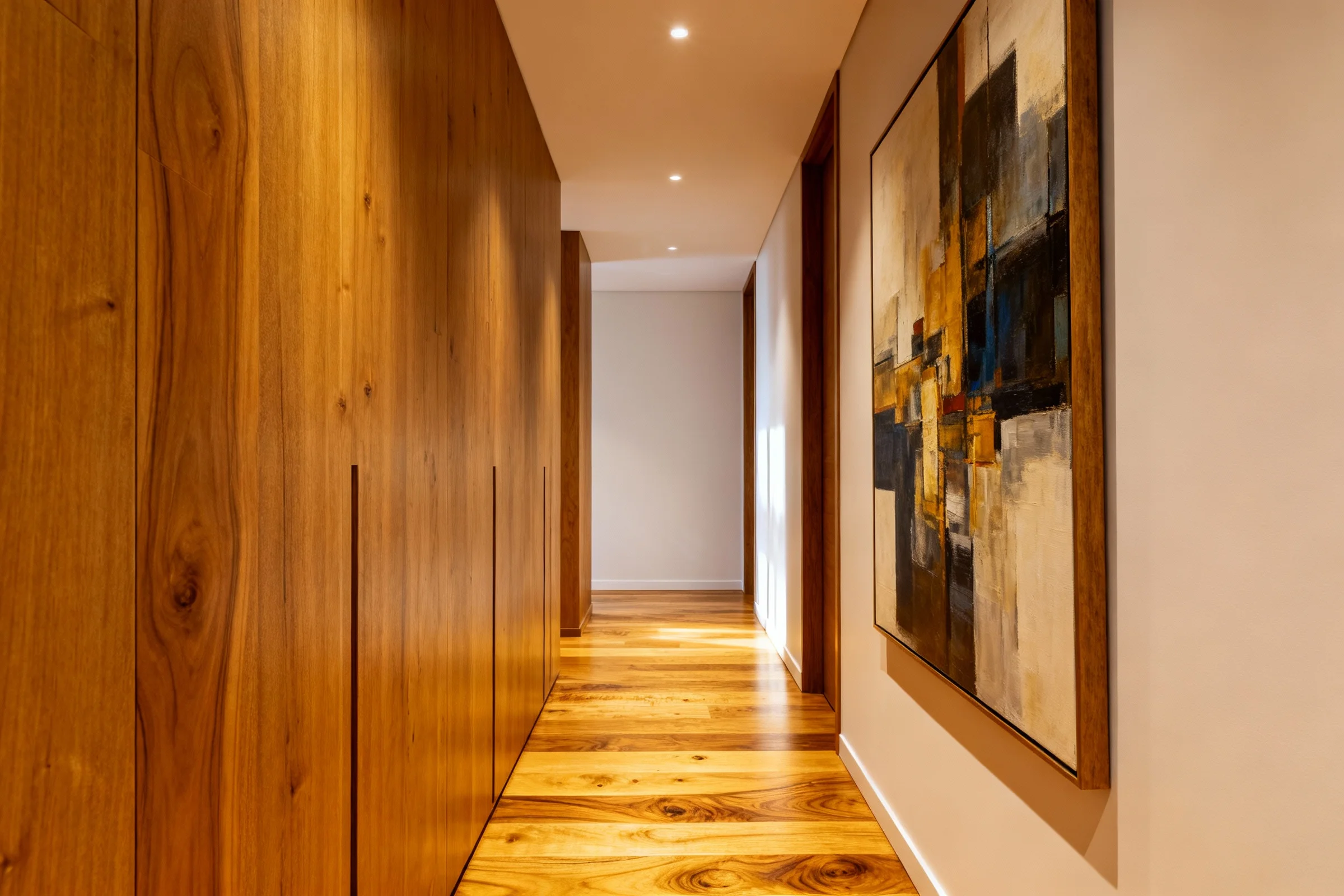
(Featured image: Modern wall art prints displayed along a warm wood-panelled hallway with natural timber flooring. Photo by VanVakarnee)
The hallway is often the most neglected space in an Australian home. It is viewed as a transitional zone—a mere thoroughfare to get from the front door to the living room or from the bedroom to the kitchen. However, in many architectural styles, from the long, dimly lit corridors of Victorian terraces in Melbourne to the breezy, enclosed verandahs of Queenslanders, the hallway represents a significant amount of wall real estate.
Leaving these walls bare can make a home feel unfinished or cold. Conversely, cluttering a tight walkway with bulky furniture is often impossible. This is where modern wall art prints become the hero of interior design. They provide personality, colour, and texture without encroaching on valuable floor space.
But styling a narrow hallway presents unique challenges. You cannot simply hang a picture and hope for the best. Viewing distances are short, lighting is often tricky, and the risk of the space feeling “closed in” is high. This guide will walk you through exactly how to select and hang art in confined thoroughfares to create a welcoming, sophisticated journey through your home.
The most common mistake homeowners make in hallways is misjudging scale. In a living room, you can stand back three or four metres to admire a piece. In a standard Australian hallway, which might be only 90cm to 1.2 metres wide, your viewing distance is incredibly limited.
When you choose modern wall art prints for these spaces, you must consider the “lean factor”. If a guest has to physically lean back against the opposite wall to see the full image, the artwork is likely too large or complex for the space.
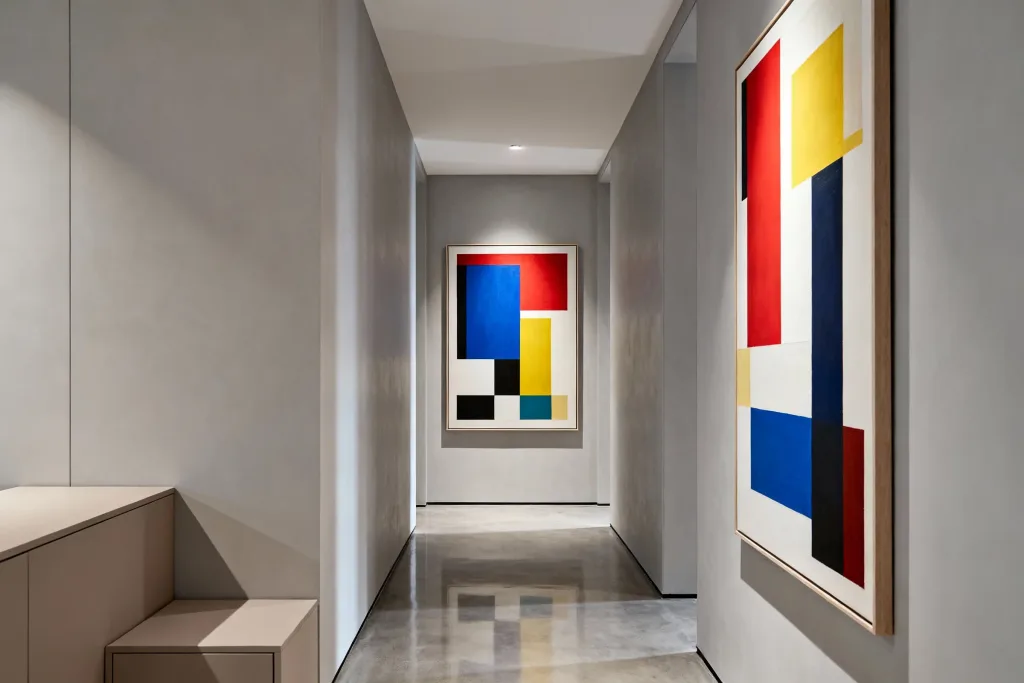
(Featured image: Modern wall art prints with bold geometric colour blocks displayed in a sleek grey hallway. Photo by VanVakarnee.)
A good rule of thumb for narrow spaces is to prioritise art that reads well from a sharp angle or close up. Highly detailed, intricate pieces often get lost in hallways because people are usually moving past them rather than standing still to analyse them.
Instead, look for large wall prints with bold shapes, clear lines, or sweeping abstract forms. These can be appreciated peripherally as you walk by. If the hallway is particularly tight, avoid oversized, heavy frames that protrude into the walkway. A sleek, minimal frame or a canvas that sits flush against the wall will save precious centimetres and prevent the “tunnel effect”.
The orientation of your artwork can dramatically alter the perception of the hallway’s dimensions.
If you are living in a modern apartment or a mid-century brick home where ceilings might be standard height (2.4m), using portrait (vertical) orientation helps draw the eye upward. This creates an illusion of height, making the tight space feel airier.
In contrast, the long “gun-barrel” hallways of older terraces can feel endless. Here, a landscape (horizontal) piece at the end of the hallway acts as a visual stop sign. It grounds the space and gives the eye a destination.
However, along the side walls of a long corridor, a series of vertical modern wall art pieces often works better than a single long horizontal piece. A single long horizontal piece can mimic the shape of the hallway too closely, reinforcing the feeling of length and narrowness. Breaking up that length with vertical intervals creates a more balanced rhythm.
Design Note: Avoid placing artwork on both sides of a narrow hallway directly opposite each other. This creates a “canyon” effect that can feel claustrophobic. Instead, stagger the artwork or keep one wall completely bare to allow the eye to rest.
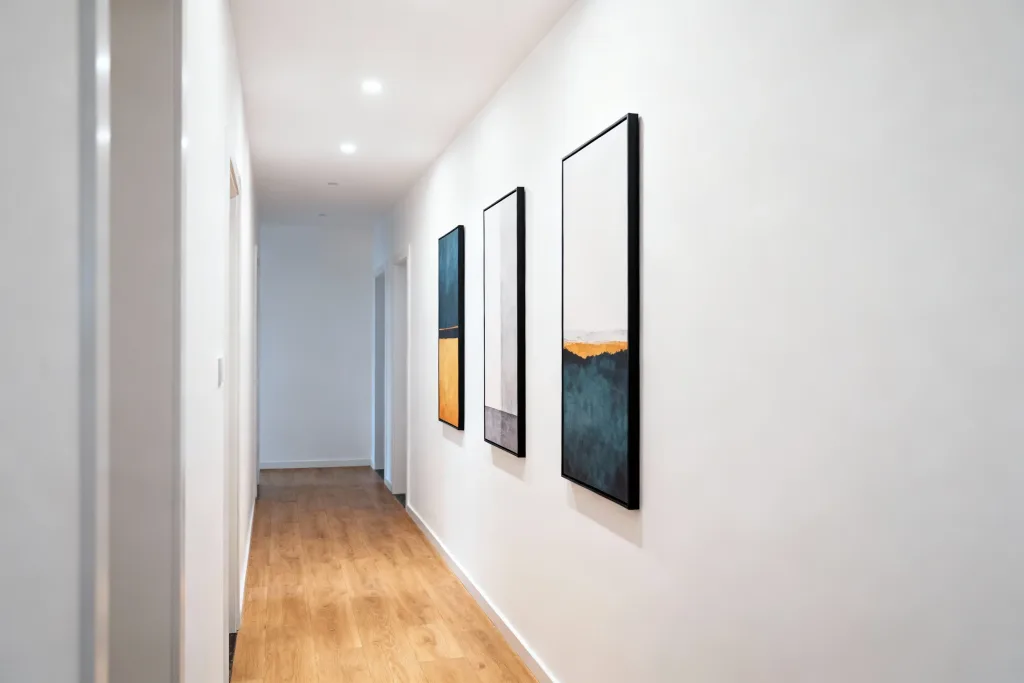
(Featured image: Modern wall art prints arranged along a bright white hallway with natural wooden flooring. Photo by VanVakarnee.)
Hallways are often the darkest parts of a home. Without windows, they rely on borrowed light from adjacent rooms or artificial overhead lighting. This lack of light can make colours look muddy and details disappear.
When selecting luxury wall art prints for a dark corridor, opt for pieces with higher contrast or lighter backgrounds. A print with a bright white mount (mat board) can act as a reflector, bouncing what little light exists back into the space. Dark, moody prints, while stylish, can turn a dimly lit hallway into a black hole.
If you have downlights installed directly over the walls (wall washers), be wary of glazing. Glass reflects glare, and in a narrow hallway, you cannot step aside to avoid the reflection.
For those looking to elevate their space, consider installing a simple picture light above a key piece. This not only illuminates the art but adds a layer of ambient light that makes the hallway feel wider and more inviting.
In a hallway, the “pacing” of your art is just as important as the art itself. This is a zone of movement. The arrangement of your frames dictates how fast or slow someone moves through the space.
If you hang a single small picture in the middle of a 5-metre wall, it looks lost and forgotten. If you hang twenty tiny pictures, it looks chaotic.
A successful approach for wall art for narrow hallway spaces is “pacing”.
Hallways are high-traffic zones. We carry groceries, move furniture, and rush children through these spaces. Ensure your high quality wall prints are secured firmly. Use two hanging points rather than one to prevent frames from swinging if brushed against.
One of the cardinal sins of interior design in small spaces is over-decoration. In a wide living room, you have the luxury of layering. In a hallway, every centimetre counts.
Abstract wall prints are particularly effective here because they often convey emotion and style without needing narrative complexity. A single, well-chosen abstract piece can do the work of five smaller, detailed photographs.
Avoid thick, ornate framing. A “floater frame” or a simple thin oak or black frame keeps the profile tight to the wall. If your hallway is less than 90cm wide, you might even consider mounting prints on Gatorfoam or using flush-mount acrylics to eliminate the frame bulk entirely.
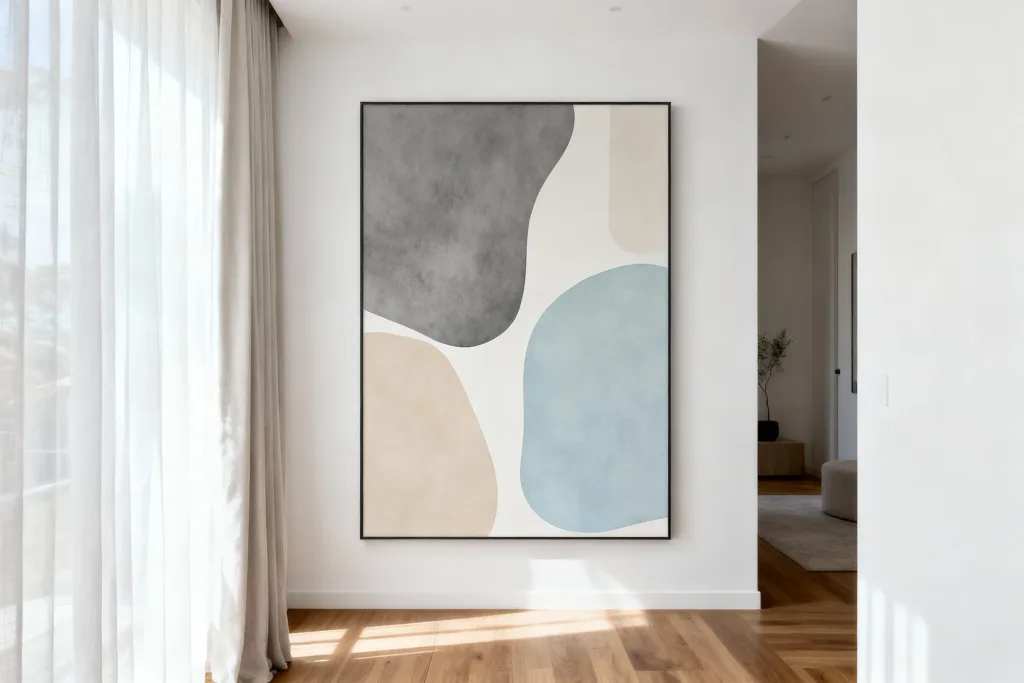
(Featured image: Modern wall art prints with soft abstract shapes displayed in a bright, minimalist interior with natural light and wooden flooring. Photo by VanVakarnee.)
Australia has a massive rental market, and many tenants feel they cannot decorate their hallways because of strict lease conditions regarding wall damage. However, leaving a hallway bare is depressing.
Because art prints for home decoration are generally lighter than heavy mirrors or shelving units, they are the perfect candidate for adhesive hanging solutions.
When selecting art for a rental hallway, consider lightweight acrylic glazing instead of glass. It significantly reduces the weight of the frame, making adhesive hooks much safer and more reliable.
Can you put a gallery wall in a narrow hallway? Yes, but proceed with caution. The traditional “salon style” gallery wall (a messy, organic collection of many sizes) can feel oppressive in a confined corridor.
The best gallery wall ideas for narrow spaces involve structure. A “grid” layout is your best friend here.
This uniformity calms the brain. It provides visual interest without the chaotic energy of a mismatched collection. For example, a
series of three medium-sized modern wall art prints running horizontally along the hallway guides the visitor through the house.
For a source on grid layouts and spacing ratios, the Design Institute of Australia often provides resources on standard interior measurements, or you can consult architectural standards for corridor width-to-decoration ratios.
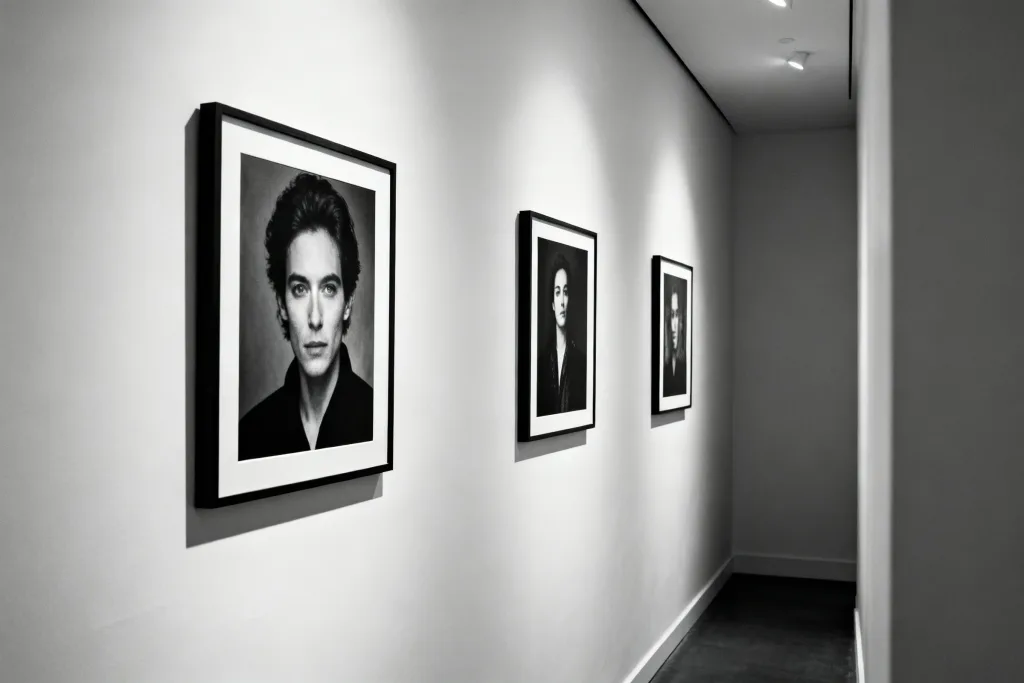
(Featured image: Framed black and white portrait photographs displayed in a minimalist hallway gallery. Photo by VanVakarnee.)
The architecture of your home dictates the “personality” of your hallway. Here is how to match your art to common Australian vernaculars.
These homes typically feature a long, dark archway leading from the front door. The walls are often plaster, sometimes with wainscoting.
Queenslander hallways are often breezeways or enclosed verandahs. They are light, airy, and feature vertical joinery (VJ) walls.
In new builds, hallways are often purely functional and lack architectural character.
For homes along the coast, the hallway is often the entry point for sandy feet and bright sun.
External design resources like The Design Files frequently showcase how Australian architects tackle these specific hallway types, offering great visual inspiration for how art integrates with structural constraints.
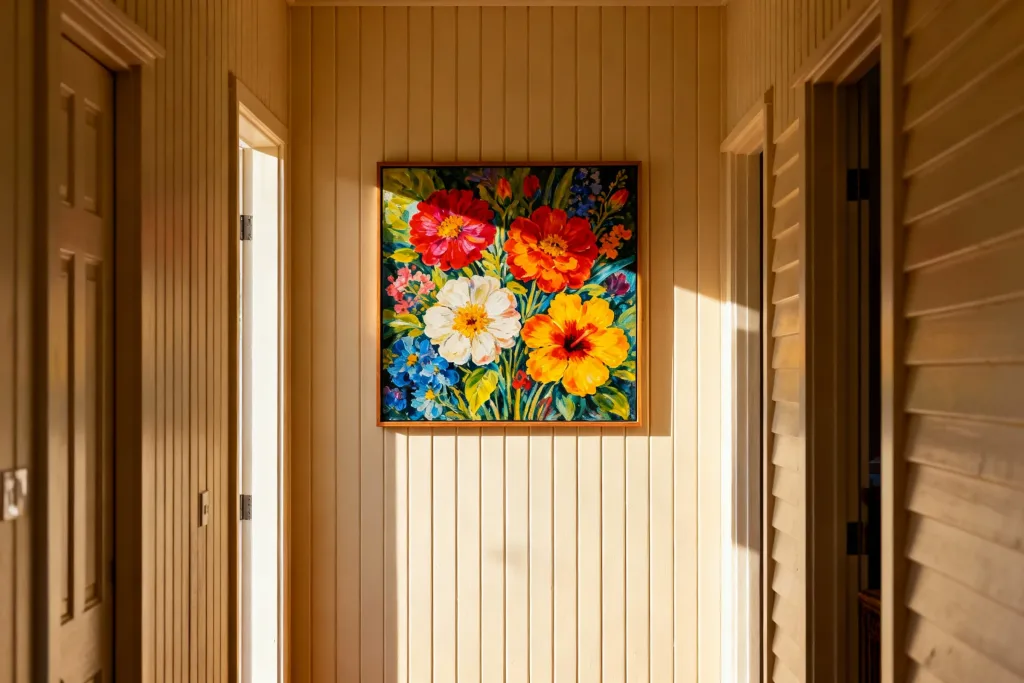
(Featured image: Modern wall art prints featuring a vibrant floral composition displayed in a sunlit hallway with vertical wood panelling. Photo by VanVakarnee.)
Finding the right balance of scale, quality, and style for a narrow space can be time-consuming. You want art that looks expensive and intentional, not like a mass-produced poster that ripples in its frame.
At Vanvakarnee, we specialise in premium, gallery-quality prints designed to elevate Australian interiors. Our collections are curated to offer distinct styles—from minimalist abstracts that suit tight apartment corridors to bold, luxurious statement pieces perfect for the end of a terrace hallway.
We understand that online wall art store shopping can be difficult when trying to gauge texture and quality. That is why we focus on high-resolution, meticulously detailed prints that hold up to the “close scrutiny” test—essential for hallways where your guests will be viewing the art from just inches away.
Whether you are looking to create a linear gallery or find that one perfect vertical piece to lift your ceiling height, our range is designed to help you finish your home with confidence.
1. What size art is best for a narrow hallway? Avoid oversized pieces that fill the entire wall. Leave at least 15–20cm of wall space on all sides of the frame. Medium-sized prints (such as A2 or 50x70cm) often work best, or a series of smaller prints arranged linearly.
2. How high should I hang art in a hallway? Eye level is the standard, which is generally 150cm from the floor to the centre of the artwork. In a hallway where people are mostly standing or walking, you can nudge this slightly higher (155cm), but never too high, or the space will feel disconnected.
3. Can I use dark art in a hallway without windows? It is risky. Dark art in a dark hallway can absorb the little available light, making the space feel smaller. It is safer to use art with a white mount (mat) or lighter colours to reflect light and open up the area.
4. How do I stop art from being knocked in a narrow corridor? Use flat-profile frames rather than deep box frames. Secure the artwork at the bottom as well as the top using adhesive velcro tabs or double hanging points to prevent it from swinging if brushed against.
5. Should I put art on both walls of a hallway? Generally, no. In narrow hallways, putting art on opposing walls can create a “tunnel” effect that feels claustrophobic. It is better to decorate one side and leave the other blank to let the eye rest.
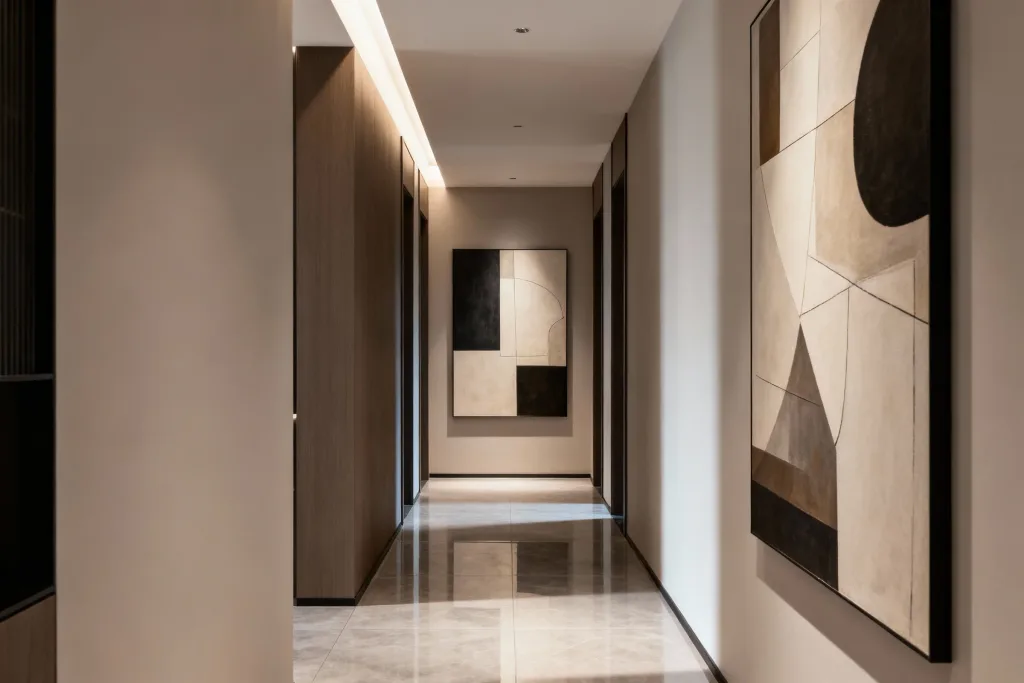
(Featured image: Modern wall art prints displayed in a refined hallway with polished stone flooring and soft architectural lighting. Photo by VanVakarnee.)